The Iran war and the ongoing energy crisis underline the urgency of driving the energy transition and phasing out fossil fuels. Renewable energies provide more independence from geopolitical tensions and crises by ensuring a secure energy supply and combining reliability with economic viability and climate protection. The transformation is unstoppable and innovations are more important than ever before. The countless submissions for The smarter E AWARD 2026 show just how progressive and advanced the industry is. An expert panel has picked the best, most innovative new developments for the shortlist. This coveted prize is awarded in five categories: Photovoltaics, Energy Storage, E-Mobility, Smart Integrated Energy and Outstanding Projects. The winners will be honored on the eve of The smarter E Europe opening on June 22 from 5:00pm at the International Congress Center Messe München (ICM). Anyone who wishes to attend the award ceremony can do so free of charge. The smarter E Europe, Europe’s largest alliance of exhibitions for the energy industry, brings together the four exhibitions Intersolar Europe, ees Europe, Power2Drive Europe and EM-Power Europe, and will be taking place from June 23–25 at Messe München.
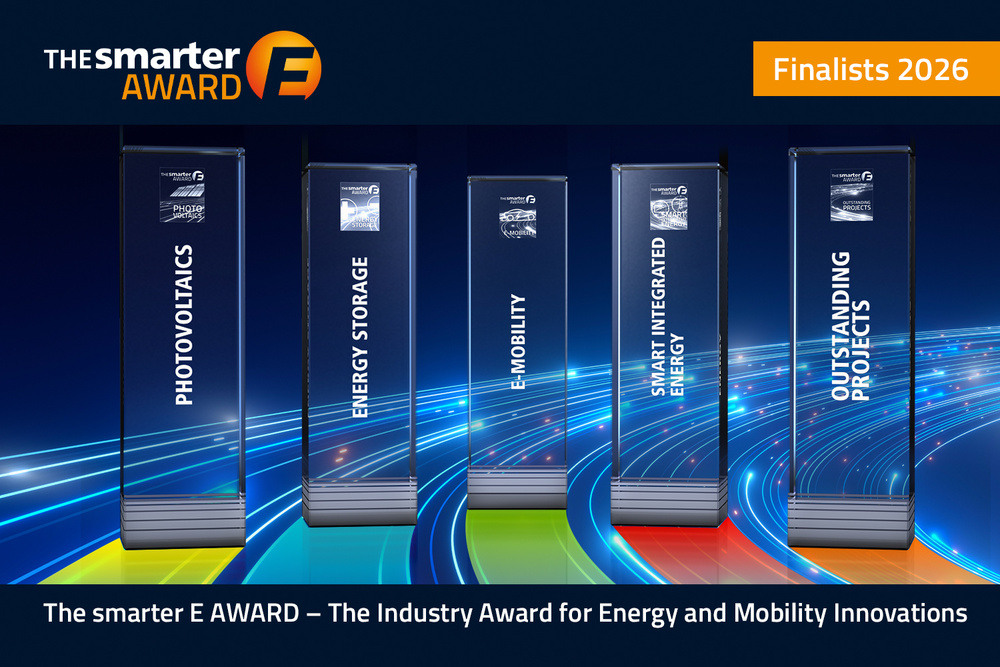
The generation of electricity from solar and wind continues to grow rapidly and is unbeatably cheap. When it comes to ensuring a comprehensive, safe and renewable 24/7 energy supply, the key challenges lie in the intelligent integration of renewable electricity into the energy system through digitalization, flexibilization solutions and AI. This also includes the massive expansion of battery and energy storage solutions. The electrification of the mobility sector is also essential for decarbonization. And above all else, the energy transition is a global endeavor. The five categories recognized within The smarter E AWARD mirror this complex situation.
A major trend in PV modules is the significant increase in shade resistance through innovative cell design and integrated bypass diodes. Other new developments include ultralight panels for structurally challenging roofs, bifacial vertical modules for green roofs, flexible plastic solar modules for mobile applications and more hail-resistant modules. Sustainability has also been moving into the spotlight thanks to lead-free interconnection technology and modules with a significantly reduced carbon footprint. When it comes to inverters, the trend is toward higher power density and voltage classes. Modern string inverters already support up to 1,000 V AC, and DC inputs for systems of up to 2,000 V. Innovations in large-scale inverters target the use of higher voltages, while reliability and resilience are also gaining significance. Other new developments include a trend towards specialized modules and the improved availability of substructures for floating PV and agricultural PV, as well as nature and species preservation solutions for PV parks.
Atmoce (Germany) for: MI series 2-in-1 microinverter that maximizes energy yield and profitability
Goldbeck Solar (Germany) for: HeliomatiX, a system that automizes the construction of utility-scale PV systems
Huawei Technologies (China) for: The 506 kW Smart String Inverter (SUN2000-506KTL), which achieves a remarkable nominal power
IED ELECTRONICS SOLUTIONS (Spain) for: TRUE WIND, a technology that can be integrated into trackers to measure wind pressure
LONGi Green Energy Technology (China) for: Hi-MO 9 Ice-Shield, a free-standing module with a special design that makes it resistant to extreme weather events
MycoNest (Hungary) for: MycoNest, a modular habitat system made from mycelium that can be integrated into free-standing PV installations
PVFARM (United States of America) for: PVFarm, a high-performance web-based platform for planning and optimizing utility-scale PV installations
SolarEdge Technologies (Israel) for: SolarEdge Inverter 3ph, a three-phase hybrid inverter for residential systems
SOLYCO Solar (Germany) for: SOLYCO SOLon35, a vertical PV system for green roofs, whose set-up minimizes shading
SOLYCO Solar (Germany) for: SOLYCO TECC-Connect – the wire connecting solar cells within a module without using silver, lead or bismuth
Battery storage trends are all about scaling and systems integration across all applications. The size of cells in large installations has been increasing, boosting energy density and storage capacity. Another focus is on modular and stackable systems, especially in 10 to 100 kWh systems for large homes or small companies. New and second-life modules can now be combined in a single stack, which improves modularity and expansion options. On the smallest scale, balcony PV installations now integrate several kWh of storage capacity and can be expanded to more than 800 W of AC power. This enables applications such as uninterruptible power supply (UPS), which has become increasingly important in commercial, industrial and residential systems. Additional functions like arc detection are also being integrated into more and more systems. AI-controlled energy management and safety controls are becoming more important across all system sizes. Sodium-ion batteries are now available alongside lithium-iron-phosphate (LFP) batteries.
CRRC Zhuzhou Institute (China) for: High Voltage Cascade System, which provides medium-voltage alternating current (10 to 35 kV) straight from the battery container
International Power Supply (Bulgaria) for: EXERON CheckMate, a modular system for large installations
minimum Energy (Germany) for: minimum energy, a cloud-based platform for industry and commerce
Ore Energy (Netherlands) for: Ore Heritage, a battery unit based on iron-oxide
PHENOGY (Switzerland) for: PHENOGY 1 Series – PHENOGY 1.0 and PHENOGY 1.1 – sodium-ion container storage
POWEROAK (Netherlands) for: BLUETTI Pioneer Na, the first portable power supply based on sodium-ions
Sigenergy Technology (China) for: SigenStor Neo, a home storage system with six stackable modules
Sungrow Power Supply (China) for: Sungrow utility-scale BESS PowerTitan 3.0, a battery energy storage system for large-scale installations
TrinaStorage (China) for: Trina Storage Elementa 3 Platform, a large-scale energy storage solution
volytica diagnostics (Germany) for: AvEn (Available Energy) – deterministic BESS dispatch KPI, which reduces uncertainty around the amount of energy available for energy trading and grid services
Many submissions in the E-Mobility category reflect the advancements in HPC infrastructure. Silicon carbide semiconductors have become the norm, and the maximum efficiency level of current transformers is rising. The power density of modules is increasing and megawatt charging continues to evolve. The range of charging solutions with peak power over 1,000 kW is growing, while the MCS standard and other megawatt charging systems are being elevated towards large-series utilization by new technical developments. Some bidirectional charging systems are now approaching series maturity.
Amperfied (Germany) for: UptimePRIME, an innovative charging-as-a-service model
Fraunhofer IVI (Germany) for: Underbody charging system, an innovative charging solution for logistics and municipal operators’ vehicle fleets
HagerEnergy (Germany) for: Bidirectional edsn EV charger – electric vehicles are integrated as energy storage systems to supply buildings
Hive Power (Switzerland) for: FLEXO, a SaaS platform which turns smart charging into a useable flexibility product
LEM International (Switzerland) for: DCES series, a new generation of DC meters for fast charging applications and megawatt charging systems
OPES Solar Mobility (Germany) for: OSM 60/875 MPPT, a DC/DC converter
Peblar (Netherlands) for: Peblar Dual, an EV charger with two Type 2 charging points
Pleevi (Belgium) for: Pleevi smart charging scheduling engine leverages AI to optimize charging
Tritium Power Solutions (Great Britain) for: TRI-FLEX, a distributed fast-charging system with integrated battery storage (BESS)
Vector Informatik (Germany) for: Smart charging connector enables the use of charging cables up to 100 meters long for charging trucks and buses
Digital integration is key
The finalists in the Smart Integrated Energy category mark a clear paradigm shift: Hardware specs have faded into the background and software architectures have become the main value driver. Unified optimization approaches dominate consumer and C&I levels, whose integrated energy management systems (EMS) do not only maximize self-consumption, but combine asset-agnostic and conflict-free revenue streams such as peak shaving, day-ahead trading and dynamic tariffs. As a result, start-ups are responding to the chronic data vacuum in the distribution system on a macro level. Using graph neural networks and AI-supported satellite image analysis (Grid Data Intelligence), they create real-time grid capacity models that will stop grid operators and project planners going in blind.
Finalists in the Smart Integrated Energy category
Blindleister (Germany) for: Grid Data Intelligence (GDI) – the platform combines load flows, redispatch data, grid capacities and other information
coneva (Germany) for: coneva Flex – a modular energy management system (EMS) for the C&I sector that focuses on comprehensive behind-the-meter optimization.
FENECON (Germany) for: Commercial 100, a hybrid inverter and energy management system, combined into an integrated C&I solution
Jiangsu Linyang Energy Storage Technology (China) for: AI-driven PV storage microgrid platform
Lumera Energy (Germany) for: Lumera OS, a universal software platform for planning, simulating and operating C&I battery storage
Meins (Spain) for: CSET (compact substation), a modular compact high-voltage station (up to 132/145 KV)
Simpl.energy (Netherlands) for: Zympler, a modern energy management system that integrates PV systems, batteries, EV charging stations, generators and industrial consumers
Stem (Germany) for: PowerTrack energy management system (EMS) that offers quick failover
The Mobility House Energy (Germany) for: TMHE multi-utility/multi-OEM vehicle-to-grid-integration (VGI) platform combining electric vehicles, bidirectional chargers, utility companies and energy markets in a single software ecosystem.
Zendure (Germany) for: SolarFlow 2400 Pro, a highly integrated home storage system for the residential market
The finalists in the Outstanding Projects category provide excellent examples of how the energy transition, humanity’s major challenge, is being tackled across the globe. The spectrum ranges from large-scale green hydrogen production and large storage projects that ensure a steady supply of ever greener electricity, to using public buildings to generate solar power and to projects providing cooling energy for food.
Arevon Energy (United States of America) for: Eland Solar-plus-Storage – the combined PV and storage system covers around 7 percent of Los Angeles’ electricity demand
Fluence (United States of America) for: DTEK and Fluence energy storage portfolio in Ukraine, which was installed across six sites within six months
IBC SOLAR (Germany) for: First agricultural PV farm with solar trackers – the Veringenstadt solar park generates around 11 GWh of electricity annually
PowereX (Slovakia) for: From backup to value: virtual power plant for telecommunications using AI to interconnect the Slovakian telecom emergency power infrastructure to form a virtual power plant
Schoonschip (Netherlands) for: Schoonschip VPP, an energy community consisting of 30 floating houses in Amsterdam that operates an intelligent grid-connected microgrid
SMA Altenso (Germany) for: Africa’s first integrated green hydrogen plant, which was built in Namibia and produces off-grid green hydrogen from solar power
SMA Solar Technology (Germany) for: 100 percent solar-powered electric vehicle charging station in Gran Canaria
Solarpro Technology (Bulgaria) for: Tenevo 238 MWp PV + 760 MWh BESS renewable energy complex, combining a PV installation with a battery storage system
suena (Germany) for: Hybrid battery operation for urban energy flexibility, a stationary battery storage at the Alsterdorf bus depot in Hamburg.
Sungrow Hydrogen (China) for: Daye Hydrogen Energy Mining Project, an electrolysis plant with hydrogen storage in a repurposed cavern in China